
Review · ATHENS
Private tour in Nafplio with Olive oil Tasting Tour in Corinth
Greece tastes better by the spoonful. This private day trip links an olive estate, the Corinth Canal, Ancient Corinth, Acrocorinth, and Nafplio in one long outing from Athens. I like the privacy of a vehicle reserved for your group and the chance to spend time with a family-run olive producer, not just stop for a quick photo. I also like that driver Ilias is praised for being punctual, friendly, flexible, and willing to share useful facts along the road. The main drawback is cost: $529.81 covers up to four people, but the olive oil tasting costs another €65 per person.
The tour lasts about eight hours and includes hotel, apartment, airport, or port pickup and return. Your air-conditioned vehicle has Wi-Fi, water, and a toilet. The driver can explain history from the road and outside the sights, but a licensed archaeologist is an extra cost if you want detailed interpretation inside Ancient Corinth or the fortresses.
The pace suits a small group that wants to see a lot without joining a bus tour. Still, this is a full day on the road. Nafplio receives about two hours, while the olive estate receives about four, so this is more of a regional sampler than a slow, extended visit to every site.
What makes this day trip useful
- A private car for up to four people: The flat group price can be sensible for a family or small party, especially when divided four ways.
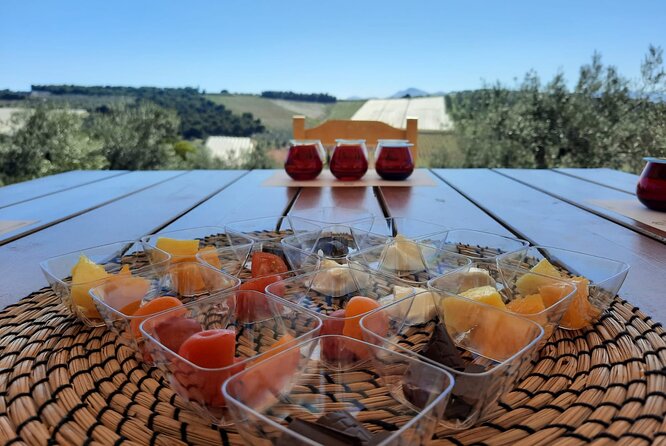
- A real olive oil focus: The visit includes a walk among old olive trees, an explanation of cultivation, and tastings paired with bread and local delicacies.
- Flexible pickup: You can arrange pickup from a hotel, apartment, airport arrivals hall, or port gate, with return to the same place or another preferred point.
- Several layers of Corinth: In a short stretch, you see the canal, the ancient city, and the hilltop fortress above it.
- A useful road companion: Ilias is praised for safe driving, humor, punctuality, communication through WhatsApp, and not rushing the group when the day runs long.
- Optional cooking class: If arranged in advance, cooking costs €25 per person and adds a hands-on food element to the olive oil visit.
From Athens to the Peloponnese

The trip begins at a time you choose, which is one of the strongest practical features here. At a hotel, you meet the driver in the lobby. At an apartment, pickup is at the building entrance. Airport pickup takes place in the arrivals hall with a name sign, while port pickup takes place at the gate after you disembark.
That arrangement removes the usual first-day puzzle of finding a taxi, locating a meeting point, or gathering a group before sunrise. It is especially handy if you are arriving by cruise ship or changing hotels. The return point can be the original pickup place or another spot you prefer.
The vehicle is air-conditioned and includes Wi-Fi, water, and a toilet. Wi-Fi is useful on a long road day, though the main value is simple comfort and not having to manage several transfers. Since this is a private trip, you can speak directly with the driver about the pace, within the limits of the eight-hour schedule.
The driver-guide is permitted to provide exterior historical information. That means you can expect context during the drive and at viewpoints, but not the full service of an archaeologist guiding you through every excavation. If ancient sites are your main reason for booking, ask in advance about adding the licensed archaeologist.
More Olive Oil Tours around Athens:
- Athens: Acropolis Wine Tasting with Cheese and Olives
★ 4.9 · 337 reviews - Athens Old Town: Greek Olive Oil & Herbs Tasting
★ 4.2 · 41 reviews - ”Athens Olive Oil Tasting”
★ 4.9 · 16 reviews
Four hours among olive trees at Oleosophia
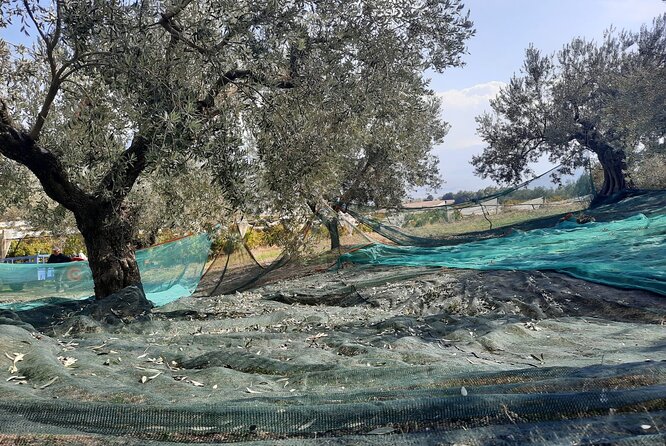
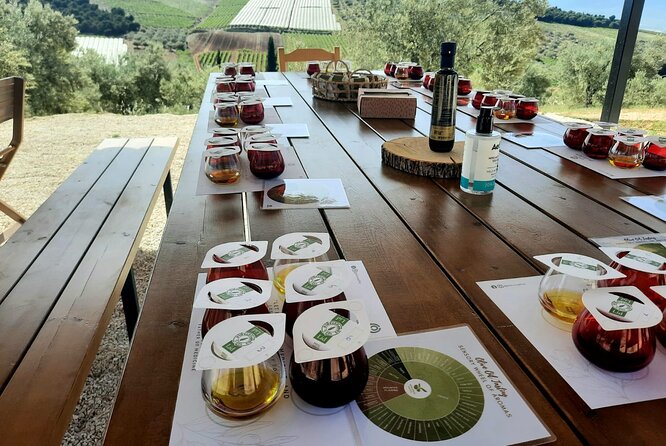
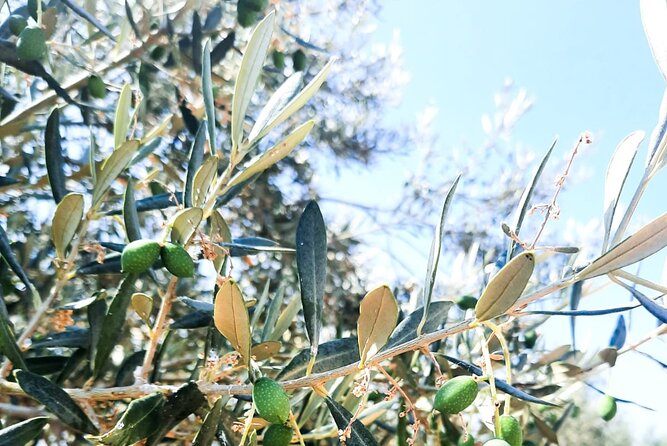
The olive estate is the heart of the experience. Oleosophia is a family-run property where olives have been cultivated across generations. You walk among old trees and learn how the fruit is cared for and harvested using traditional methods.
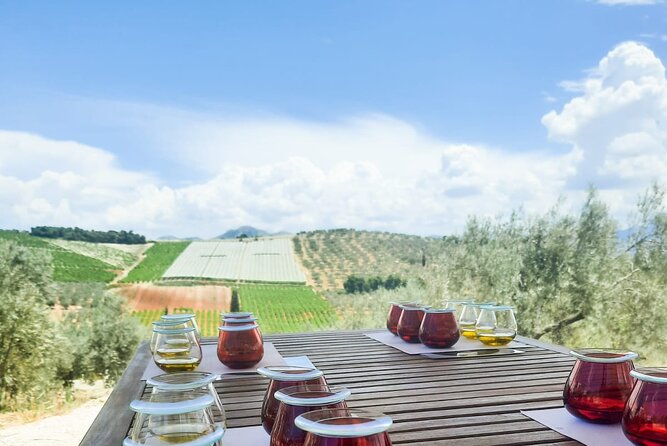
That setting gives the tasting more meaning than a simple counter with several bottles. You connect the oil to the trees, the family, and the local agricultural tradition before tasting it. The focus is on aroma and flavor, with guides explaining differences between olive varieties and premium oils.
Fresh bread and local delicacies accompany the samples. This matters because olive oil can be difficult to judge on its own, especially if you are used to supermarket oil rather than fresh regional production. The food also turns the tasting into a light meal, though you should not assume it replaces lunch unless the provider confirms that directly.
The four-hour allocation is generous compared with the other stops. You have time for the grove, the explanation, the tasting, and perhaps the optional cooking class without treating the estate as a rushed roadside break. The cooking class costs €25 per person and must be requested, so ask about availability before booking.
The olive tasting costs €65 per person and is not included in the tour price. For four people, that adds €260, making the total price noticeably higher than the headline group fare. I would treat this as a food-and-culture experience rather than a cheap sightseeing stop. If you already plan to buy Greek olive oil, the visit may also help you understand what you are purchasing, though no specific bottle or shopping arrangement is promised.
One useful point: the family atmosphere is part of the appeal. The experience has been praised for its warm welcome and for making the group feel personally looked after. That is a good fit if you prefer conversation and local connection over a polished, large-scale attraction.
The Corinth Canal in 20 minutes
The Corinth Canal is a quick but worthwhile stop. It cuts through the Isthmus of Corinth, linking the Gulf of Corinth with the Saronic Gulf. The canal stretches about 6.4 kilometers and was completed in 1893 after centuries of failed or abandoned plans.
The story is unusually long for such a short visit. Periander proposed the idea in the seventh century BCE. Instead of cutting through the isthmus, ancient engineers built the Diolkos, a paved route used to move ships overland. Julius Caesar and Nero also considered the canal, but construction did not begin until the nineteenth century.
You have about 20 minutes here, with no admission charge. That is enough for a look, photographs, and a short explanation, not a full study of the engineering. The canal is too narrow for the largest modern ships, yet smaller vessels still use it.
I like this stop because it breaks up the drive and gives you a clear sense of why Corinth mattered. The practical warning is simple: do not expect a long walk, boat ride, or museum visit. It is a compact viewpoint stop in a day already packed with major places.
Ancient Corinth and the world of Paul
Ancient Corinth receives about one hour. The city occupied the isthmus between mainland Greece and the Peloponnese, a position that supported commerce and political power. It flourished in both Greek and Roman periods, was destroyed by Rome in 146 BCE, and was rebuilt by Julius Caesar in 44 BCE as a Roman colony.
The site also carries major Christian significance. The Apostle Paul visited Corinth around 50 CE during his second missionary journey and stayed for about 18 months. His letters to the Corinthians later became part of the New Testament, addressing questions of morality, unity, and faith.
Among the ruins, the Bema is linked to Paul’s preaching. The remains also point to Corinth’s wider role as an urban and administrative center, rather than presenting the city only through its Christian connection.
One hour is enough for an introduction, but it is not generous for every corner of the archaeological site. Admission is not included. The driver can provide exterior information, while an optional licensed archaeologist can accompany you for a fuller explanation. I would add the specialist if Ancient Corinth is a central interest, especially if you want help distinguishing Greek, Roman, and early Christian features.
The hour also depends on how much time the olive estate and Nafplio use. Since the day can run long, confirm how flexible the schedule is and which stop would be shortened if you spend extra time at the ruins.
Same groves, a different afternoon:
- Street food tasting in the locals favorite hidden places
★ 5.0 · 15 reviews - From Athens: Olive Oil Tasting, Olive Grove & Wine Experience
★ 5.0 · 13 reviews - Full-Day Private Tour Corinth and Olive Oil Tasting from Athens
★ 5.0 · 13 reviews - Athens: Cretan Olive Oil Tasting Experience
★ 5.0 · 10 reviews
Acrocorinth, the fortress above the plain
Acrocorinth receives about 40 minutes and offers a very different experience from the lower archaeological site. The fortified rock rises more than 570 meters above Corinth, giving it control of the surrounding plains and nearby seas.
The site was strengthened by many powers over the centuries. Romans, Byzantines, Franks, Venetians, and Ottomans all added to or altered the defenses. The walls and gates therefore tell a long military story, while the earlier Temple of Aphrodite connects the rock to ancient religion and myth.
Fortress visits require a little more physical effort than a flat town walk, although the tour details do not specify accessibility conditions. Wear sensible shoes and ask about the walking surface if anyone in your group has mobility concerns. Forty minutes allows a look at the gates, walls, and views, but not a leisurely exploration of the entire hilltop.
The short visit is still valuable because Acrocorinth explains why Corinth was so important. From above, the canal, isthmus, and routes through the Peloponnese make more sense. You see the defensive logic that shaped the site for centuries.
Two hours in Nafplio
Nafplio is the final major stop, with about two hours to explore independently. It was the first capital of modern Greece after independence in 1821 and served as an early political and cultural center.
The town is known for narrow streets, neoclassical buildings, squares, and a waterfront promenade. Its two famous fortifications are Palamidi, the large Venetian fortress on the hill, and Bourtzi, the small fortress on an islet in the harbor.
With only two hours, you need to choose your priorities. You can walk through the old center, pause at a cafe, follow the waterfront, or focus on a fortress view. You are unlikely to give every part of Nafplio the attention it deserves in this timeframe, and the tour does not include admission tickets for attractions.
I like the balance here. After olive oil and archaeological ruins, Nafplio gives you a chance to walk, eat, and enjoy a town rather than another excavation. It is also a useful introduction if you are considering returning for a longer stay or pairing it with nearby Mycenae and Epidaurus on another day.
The timing may be the main compromise. If you want to climb Palamidi, explore the old streets, and linger by the harbor, two hours will pass quickly. Ask how the driver handles delays, especially if you plan to spend longer at the estate or Ancient Corinth.
What the private price really buys
The base price is $529.81 per group of up to four people. That works out to about $132.45 each if four people share the vehicle, before the olive tasting fee. For two people, the per-person cost is much higher, but you still receive a private vehicle, flexible pickup, and a full day connecting places that are spread across the region.
The €65 per-person olive tasting is the largest extra cost. The optional cooking class adds €25 per person. Ancient-site admission fees are also not included, and a licensed archaeologist costs extra.
I would compare this with the value of time and control, not only with the sticker price. You avoid arranging several transfers and can start from your own accommodation. You also avoid being tied to a large group’s pace. For a family of four, a couple celebrating a special day, or a small group arriving by ship, those advantages may justify the cost.
For a solo visitor or a pair focused mainly on low-cost sightseeing, the price may feel steep. In that case, decide if the olive estate is the main goal. If it is, the tasting fee is easier to accept as the price of a specialist food experience. If you mainly want Ancient Corinth and Nafplio, a less expensive transport option might make more sense, though it would not offer the same door-to-door convenience.
The driver can shape the day
The strongest practical praise centers on Ilias. He is described as dependable, punctual, friendly, funny, and easy to reach through WhatsApp. He has also been praised for safe driving and for sharing facts while passing places along the road.
That last point matters on a long transfer day. A private driver who helps you understand what you are seeing turns road time into part of the experience. Ilias has also been willing to let a group continue when the day ran about an hour over, without rushing them. Do not treat that as guaranteed, but it suggests a useful level of flexibility.
Panagiotis is also associated with private trips from Athens and the countryside. If more than one driver may operate the tour, confirm who will be assigned to your group and what language support is available. English is offered.
Because the driver is not a licensed archaeologist, keep your expectations clear. You get a capable road companion and exterior historical context, not necessarily a site specialist at every ruin. Adding the archaeologist is the better choice for serious archaeology interests.
Who will enjoy this most
I would recommend this day for:
- A group of up to four that values privacy and direct pickup.
- Families who want a flexible vehicle rather than a fixed bus schedule.
- Food lovers interested in Greek olive oil and traditional cultivation.
- Cruise passengers needing port pickup and return.
- First-time visitors who want a broad look at Corinth and Nafplio.
- People who enjoy combining food, scenery, ruins, fortresses, and a coastal town.
I would think twice if you prefer slow travel. The day covers several places, and Nafplio and Ancient Corinth each receive limited time. It is also less suitable if you want a full archaeological lecture without paying for the optional specialist.
Free cancellation is available when you cancel at least 24 hours before the start time. Changes or cancellations inside that window are not accepted for a refund, so keep the cutoff in mind before committing to the extra tasting or cooking class.
Should you book this tour?
Book it if you want a private regional day trip that adds Greek food culture to major historic sights. The olive estate is the distinctive feature, while the Corinth Canal, Ancient Corinth, Acrocorinth, and Nafplio give the day variety.
Before booking, confirm three things: the final cost with the €65 tasting, the admission fees for the sites you plan to enter, and whether you want a licensed archaeologist. If your group has four people and enjoys a full schedule, the value is strong. If you want an unhurried Nafplio visit or detailed archaeology, choose a slower, more specialized outing instead.
FAQ
How long does the private tour last?
The experience lasts approximately eight hours.
How many people can join the private tour?
The price covers one private group of up to four people.
What does the tour cost?
The listed price is $529.81 per group of up to four people. Olive oil tasting, cooking class fees, site admission, and an optional licensed archaeologist cost extra.
Is olive oil tasting included?
No. The olive oil tasting costs €65 per person.
Is a cooking class available?
Yes. A cooking class can be arranged upon request and costs €25 per person.
Where can pickup take place?
Pickup is available from a hotel, apartment, airport, or port. Hotel pickup is in the lobby, apartment pickup is at the building entrance, airport pickup is in the arrivals hall, and port pickup is at the gate after disembarkation.
Is transportation private?
Yes. Only your group participates, using an air-conditioned private vehicle.
Is a licensed guide included at the archaeological sites?
No. The professional driver-guide can provide exterior historical information. A licensed archaeologist can be added for an extra fee.
What is included in the vehicle?
The vehicle includes air conditioning, Wi-Fi, water, and a toilet.
Just added around Athens
- Athens: Greek Wine & Olive Oil Tasting at Brettos Plaka★ 4.5 · 3 reviews
- Breakfast in the markets with olive oil and honey tasting★ 4.8 · 8 reviews
- Private Wine & Olives Tasting Experience: Beach View Villa Paros★ 5.0 · 2 reviews
- Relax Day: Thermal Lake, Olive Oil Tasting & Poseidon Temple Tour★ 5.0 · 5 reviews
- ATHENS OLIVE ESTATE – Olive Oil Workshop with Farm-to-Fork Lunch★ 5.0 · 6 reviews
- Flavors of Greece: Olive Oil and Wine Tasting Tour in Athens★ 5.0 · 2 reviews
- Keramikos Olive Oil Experience & Walking Tour★ 5.0 · 6 reviews
- Sounion Highlights: Vouliagmeni, Olive Farm, Poseidon Temple, Thorikos Theatre★ 4.5 · 3 reviews
Athens Olive Oil Tours, compared.


Athens Old Town: Greek Olive Oil & Herbs Tasting
Read our review →

Street food tasting in the locals favorite hidden places
Read our review →
Full-Day Private Tour Corinth and Olive Oil Tasting from Athens
Read our review →
Olive Oil Tasting, Olive Grove & Wine Experience
Read our review →

Browse the lists this tour appears in