
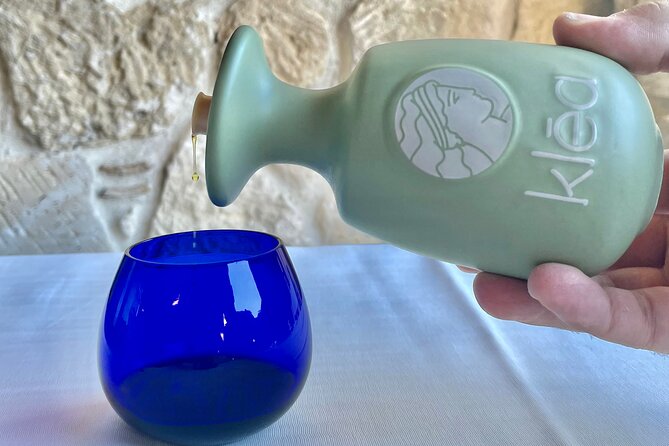
Review · HALKIDIKI
Greek Olive Oil Tasting Experience in Halkidiki
Olive oil deserves a proper tasting. This one-hour experience in Afitos turns an everyday kitchen staple into the main event. With olive oil taster Harry guiding you in English, you smell and taste Greek extra virgin oils, compare varieties from different regions, and learn how to spot freshness, defects, bitterness, and peppery heat.
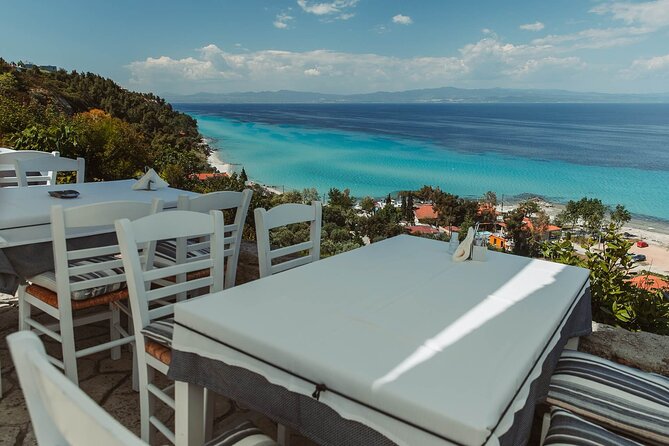
I like the private terrace above Thea Thalassa restaurant, where the sea view gives the session a pleasant holiday setting. I also like the practical teaching: Harry explains how olives are harvested and processed, then helps you connect those details with what you smell and taste. The main consideration is the price, $71.01 per person for about an hour, especially since transportation and any special meal are not included.
Key points to know before booking
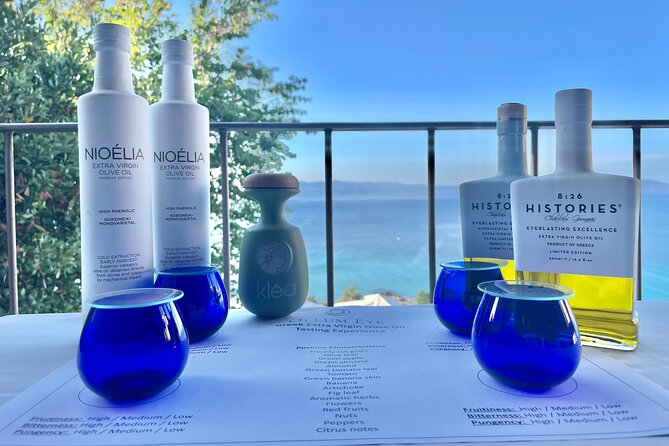
- Four Greek oils to compare: You taste oils from different Greek regions rather than sampling only one house product.
- A hands-on lesson: You learn to use terms such as fruity, bitter, and spicy, then apply them yourself.
- Sea-view setting: The private terrace above Thea Thalassa restaurant adds atmosphere without requiring a separate sightseeing trip.
- Optional food pairing: You can choose a special menu after the tasting to see how olive oil changes with food.
- Private for your group: Only your party takes part, making it easier to ask questions and set the pace.
- Easy cancellation window: You can cancel at least 24 hours ahead for a full refund, subject to the stated weather and minimum-participant conditions.
Meeting Harry above Thea Thalassa
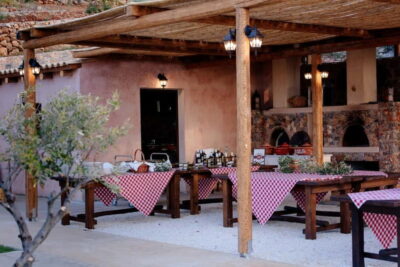
The experience starts at Thea Thalassa in Afitos, Halkidiki. You meet at the restaurant, then head to its private terrace above the dining room. The setting includes a sea view, which gives the tasting more character than a lesson held in a plain indoor room.
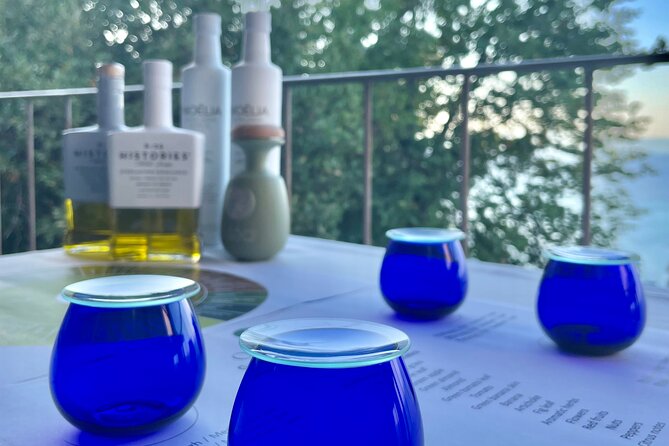
Harry is the host and olive oil taster. His fiancée also helps welcome you and prepare the setting. The table is arranged with several bottles of oil, tasting materials, and food used later for pairings. The setting feels personal and carefully prepared rather than like a quick sample at a shop.
You should allow roughly one hour for the core activity. The description also allows for an optional special menu after the tasting, so your total time can be longer if you choose to stay for food and wine. Since the activity ends back at the meeting point, you do not need to arrange a separate return transfer.
The activity is offered in English. It is described as private, so your own group takes part rather than being combined with strangers. That matters here because tasting works best when you can ask simple questions, compare impressions, and admit that one oil smells like something entirely different from what another person detects.
More Olive Oil Tours around Greece:
- Crete: Quad Safari, Olive Mill with Tasting & Ghost Village
★ 4.9 · 1,004 reviews - Knossos-Zeus Cave -Old Traditional Villages-Olive Oil Factory
★ 5.0 · 694 reviews - The Governor’s Olive Mill Tour with Olive Oil Tasting
★ 5.0 · 502 reviews
First lesson: what extra virgin really means
The session begins with an explanation of olive oil production. You learn about harvesting the fruit and the steps that follow before the oil reaches a bottle. This opening gives you useful context, especially if you have always treated extra virgin as a general marketing phrase rather than a specific quality category.
The aim is not to turn you into a professional taster in sixty minutes. It is to give you a reliable starting point for shopping and cooking. You learn that good oil has recognizable aromas and flavors, while a defective oil can reveal faults through unpleasant smells or tastes.
This part should suit beginners well. The teaching is presented in a clear way, without assuming that you already know technical tasting language. Harry’s enthusiasm is a major part of the session, but the useful point is that he links his explanations to what you have in front of you.
You also hear how Greek olive oil differs from seed oils sold on the market. That comparison helps put the tasting into everyday terms. You are not simply being told that Greek oil is good. You are asked to notice texture, aroma, sweetness, bitterness, and heat for yourself.
Smelling and tasting four Greek oils
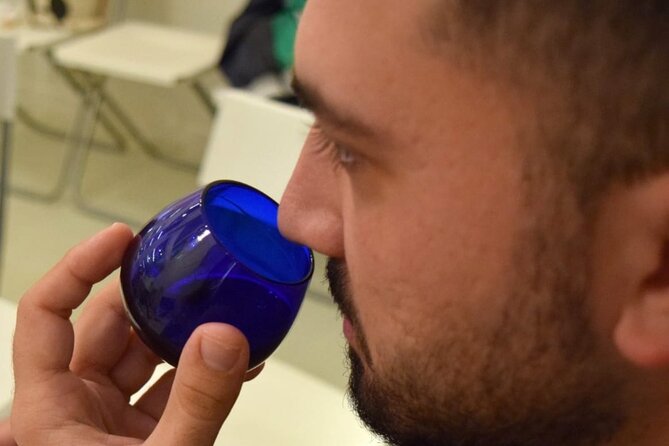
The central part of the experience compares four extra virgin olive oils from different Greek regions. This is where the lesson becomes more than a talk. You taste the oils on their own, allowing each one to show its own character before food changes your impression.
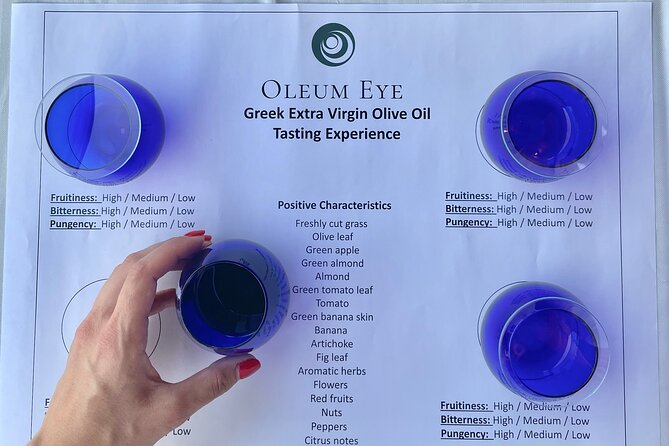
Harry introduces words such as fruity, bitter, and spicy. These can sound vague until you use them side by side. One oil may seem soft and smooth, another may have a clear peppery finish, and another may show more bitterness. The point is not to choose a single winner. It is to understand that extra virgin olive oil can have a broad range of flavors.
Give yourself time at this stage. Smell first, taste carefully, and notice what remains after you swallow. You may find the differences surprising, particularly if you normally pour oil straight onto bread or into a pan without tasting it alone.
A useful lesson here is that bitterness and peppery heat are not automatically faults. They can be signs of a lively oil, depending on the balance and the overall taste. The session helps you separate those normal traits from flaws that suggest poor storage, age, or bad production.
Learning to spot a defective oil
The tasting also covers how to distinguish a defective oil from a good one. That is one of the most useful parts for anyone who buys olive oil at home. Labels can tell you only so much. Your nose and palate give you another way to judge what you are buying.
You learn to pay attention to unpleasant or stale notes rather than accepting every bottle labeled extra virgin. The lesson also reinforces the difference between a formal category and a vague claim about quality. Afterward, you should have a better idea of what fresh, well-made oil can smell and taste like.
This does not mean the experience provides a laboratory test or a professional certification. It gives you sensory tools. You can use those tools when comparing oils in your kitchen, choosing a bottle as a gift, or deciding which oil works best for finishing a dish.
The education has a practical payoff. If you spend more on a good bottle, you will have a better chance of recognizing what you paid for. If you prefer a cheaper oil for cooking, you can still understand how it compares rather than relying only on the label or price.
Same groves, a different afternoon:
- From Chania: Olive Oil, Wine, Cheese & Honey Tasting Tour
★ 4.6 · 490 reviews - Crete: Road-trip to Lasithi, Zeus Cave & Olive Mill Farm
★ 4.4 · 451 reviews - Heraklion: Olive Farm Tour with Tasting of Local Delicacies
★ 4.9 · 411 reviews - Lassithi, Zeus Cave, Olive Mill Farm & Knossos Combo Tour
★ 4.6 · 404 reviews
Pairing oil with food and wine
After tasting the oils by themselves, you can pair them with different foods. This is where the flavor lesson becomes easier to remember. A mild oil may work well with delicate food, while a stronger and more peppery oil may bring more character to a heartier dish.
The optional special menu is a useful addition if you want more than a tasting lesson. One account of the experience describes a meal served with wine after the theory and oil comparisons. The supplied information presents this menu as a choice, so you should confirm the exact cost and contents when booking.
I like this option because it connects the lesson to real meals. Olive oil is rarely consumed by the spoonful at home. You use it with bread, salads, vegetables, fish, meat, or other foods. Pairing lets you see how an oil can change once it meets salt, texture, acidity, and other ingredients.
The menu is not included in the stated $71.01 price. That makes the activity easier to judge: the core cost covers the guided tasting and bottled water, while the meal is an optional extra. If you are watching your budget, you can stop after the tasting. If this is a special occasion, the food and wine can make the visit feel more complete.
The value of a $71.01 tasting
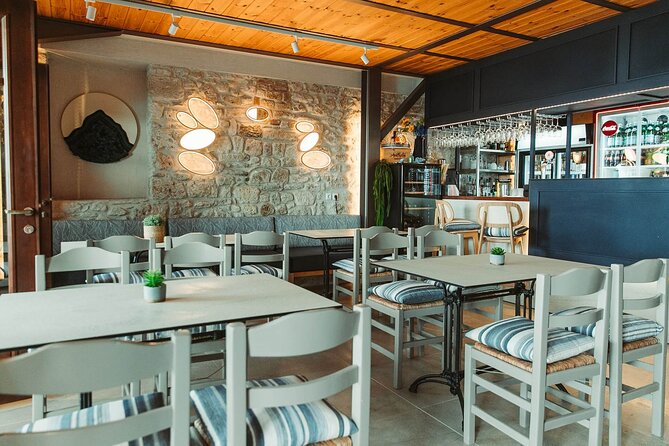
At $71.01 per person, this is not a casual free sample. You are paying for a private English-language lesson, the chance to compare several Greek oils, and a host who focuses on explanation rather than a quick pour and sales pitch.
The price makes the most sense for people who enjoy food, cooking, Greek produce, or hands-on learning. It can also work well as a gift, particularly for someone who likes culinary experiences more than ordinary sightseeing. One couple used it as a holiday gift, and the private sea-view setting suited a romantic occasion.
The value is less clear if you only want to taste one local oil or buy a bottle cheaply. You could spend less at a market or shop, but you would not get the structured comparison, production explanation, or guidance in describing what you taste.
You can buy the oils at the end, but there is no pressure to do so. That is important. The purchase option adds convenience if you find a favorite, while the absence of a hard sell lets you concentrate on the session itself. Bottled water is included, but private transportation is not.
Group discounts are available, which may improve the price for a larger party. Since the activity is private for your group, ask about the discount when arranging your booking. The exact saving is not specified.
Who will enjoy this most
I would recommend this experience to anyone who likes food with a story behind it. It is especially suitable for home cooks, people interested in Greek ingredients, couples looking for a gentle special-occasion activity, and families or friends who enjoy tasting together.
It also suits beginners. You do not need a trained palate or previous knowledge of olive oil. The lesson starts with basic ideas and builds toward comparison, so you can take part even if your usual vocabulary begins and ends with good or not good.
The activity may be less suitable for anyone unable to smell or taste because of a medical condition. Smell and taste are the entire point of the session, so this is an important consideration before booking.
It is also a modest activity in length. If you want a full-day food tour, a farm visit, or a large-scale cooking class, this is not that. It is a focused tasting with an optional meal, and its strength is concentration rather than variety.
Practical details for your Halkidiki day
The meeting point is Thea Thalassa, Afitos 630 77, Greece. The location is near public transportation, but private transportation is not included. Plan your route before the appointment, especially if you are staying outside Afitos.
The experience is listed as about one hour. Arrive ready to begin at the stated time, since the tasting works as a sequence and the food comparisons make more sense when you follow the host’s order.
Confirmation is provided at booking. The experience can be canceled without a fee if you cancel at least 24 hours before the local start time. Changes or cancellations inside that window are not accepted for a refund.
Good weather is required. If poor conditions force a cancellation, you are offered another date or a full refund. The activity also requires a minimum number of participants, and if that condition is not met, you are offered another date, another experience, or a full refund.
The activity returns to the meeting point. That is useful if you plan lunch, a walk through Afitos, or another nearby stop afterward, though the exact timing will depend on whether you add the optional menu.
Should you book this olive oil experience?
Book it if you want a personal, food-centered activity that teaches you something you can use after your holiday. The strongest reasons are the four-oil comparison, Harry’s clear enthusiasm, the private terrace above Thea Thalassa, and the chance to pair oils with food rather than tasting them in isolation only.
Think twice if $71.01 feels high for a one-hour activity, or if you are mainly looking for transportation, sightseeing, or a full meal included in the base price. The optional menu costs extra, and you must make your own way to Afitos.
For a couple, family, or small group with an interest in Greek food, I think the experience offers a memorable change from beach time. You leave with more than a souvenir bottle. You leave knowing what to smell, what to taste, and why two Greek olive oils can behave so differently on the same table.
FAQ
Where does the olive oil tasting take place?
It takes place at Thea Thalassa, Afitos 630 77, Greece, on a private terrace above the restaurant.
How long does the experience last?
The tasting lasts about one hour. The total visit may be longer if you choose the optional special menu afterward.
What language is the tasting offered in?
The experience is offered in English.
Is the activity private?
Yes. Only your group participates in the activity.
How many olive oils will I taste?
The tasting includes four extra virgin olive oils from different regions of Greece.
Is food included in the price?
Food is not listed as part of the included items. You can choose a special menu after the tasting, and the exact additional cost should be confirmed when booking.
Is transportation included?
No. Private transportation is not included. The meeting point is near public transportation.
What is included in the $71.01 price?
The price includes the guided olive oil tasting and bottled water. Group discounts may be available.
Can I cancel for a full refund?
Yes, if you cancel at least 24 hours before the experience start time. Cancellations or changes made less than 24 hours ahead are not refunded. Poor weather or failure to meet the minimum number of participants may lead to an alternative date or a full refund.
Just added around Greece
- Athens: Greek Wine & Olive Oil Tasting at Brettos Plaka★ 4.5 · 3 reviews
- Breakfast in the markets with olive oil and honey tasting★ 4.8 · 8 reviews
- PRIVATE RHODES TOUR + Lunch Stop & WINE/OLIVE OIL Tasting★ 5.0 · 2 reviews
- Olive Tour & Tasting★ 5.0 · 4 reviews
- Olive Facility Visit with Olive Oil Tasting Session★ 5.0 · 2 reviews
- SYSTASIS Olive Oil Tasting Experience in Ermioni Greece★ 5.0 · 4 reviews
- Olive Oil Tour close to Nafplio★ 4.5 · 3 reviews
- Olive Oil Tasting at the Mykonian Farm★ 4.5 · 3 reviews
Greece Olive Oil Tours, compared.


Knossos-Zeus Cave -Old Traditional Villages-Olive Oil Factory
Read our review →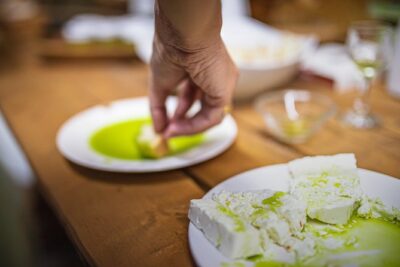
The Governor’s Olive Mill Tour with Olive Oil Tasting
Read our review →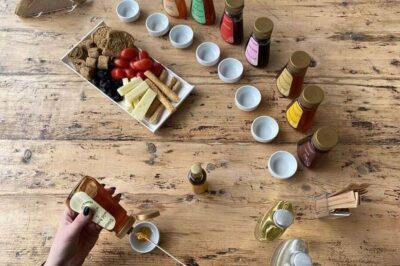
Road-trip to Lasithi, Zeus Cave & Olive Mill Farm
Read our review →
Olive Farm Tour with Tasting of Local Delicacies
Read our review →
Lassithi, Zeus Cave, Olive Mill Farm & Knossos Combo Tour
Read our review →
Zeus Cave, Lassithi Plateau, Olive Oil Factory, Kritza, Pottery
Read our review →Browse the lists this tour appears in