
Review · APULIA
Ostuni: Masseria tour among thousand-year-old olive trees with oil tasting
Some olive trees are older than empires. At Masseria Rienzo, you walk among trees estimated at 1,000 to 3,000 years old, then enter an underground oil mill cut into the rock. I especially like the way this tour connects living farmland with ancient history, and I like that the modern mill shows how the same family tradition works today. The main drawback is that the tasting is fairly brief, and the farm is easiest to reach by car or taxi.
For $33, the 1.5-hour visit offers a lot: a guided walk, two very different mills, three olive oils, friselline, and water. Guides such as Julia and Chiara are praised for explaining both the family story and the practical work behind extra-virgin olive oil in clear English.
Five things that make this Ostuni olive farm visit worthwhile
- Ancient trees with working roots: You see olive trees that still produce fruit after many centuries, including specimens described as around 2,000 or even 3,000 years old.
- Two mills, two eras: An underground cave mill shows older production methods, while the modern mill presents the current process.
- A useful oil tasting: Three farm oils help you notice differences in aroma, flavor, and quality.
- A family-run setting: Guides connected with Masseria Rienzo explain the farm’s work and traditions in a personal way.
- Strong value near Ostuni: At $33, the tour combines history, farming, food, and a tasting without taking half a day.
Why the ancient olive trees are the real beginning
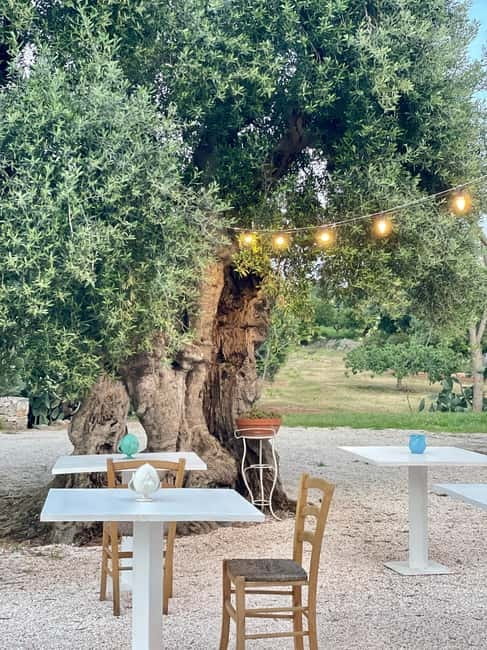
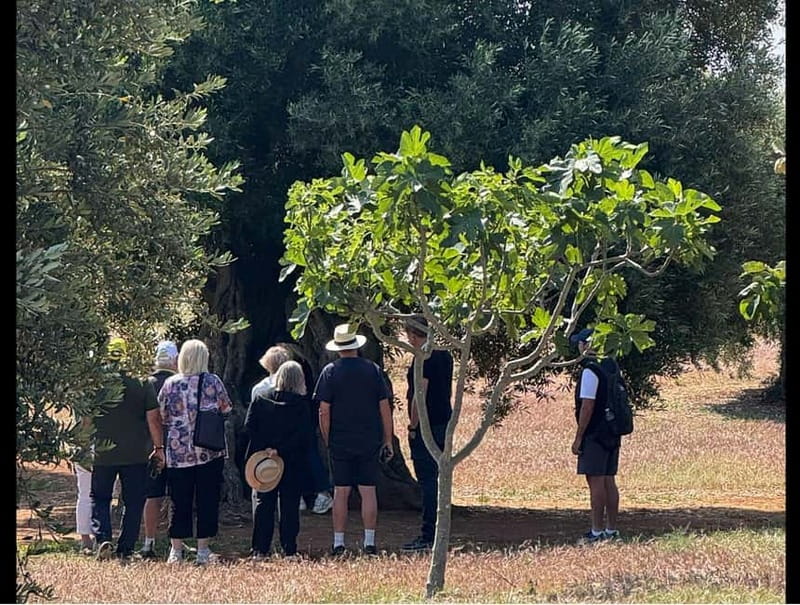
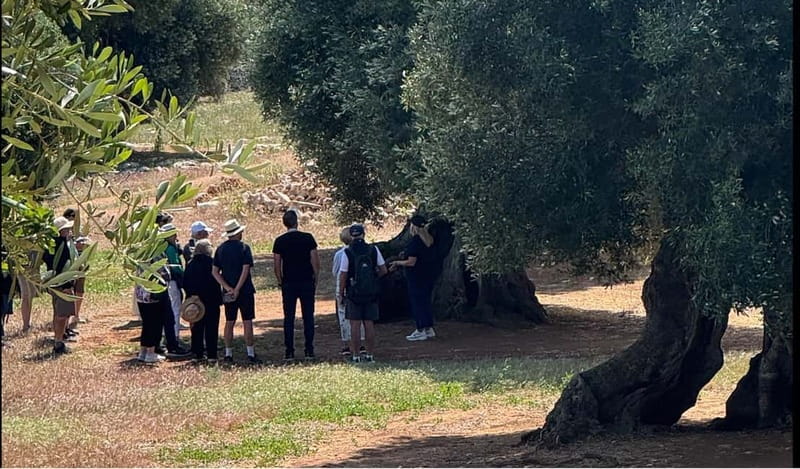
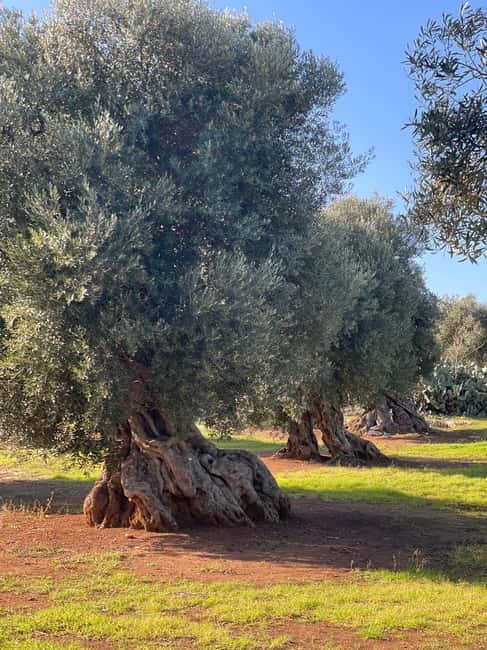
The tour starts at Masseria Rienzo and heads into the olive grove. This is not simply a pretty walk past neat rows of young trees. The striking feature is the age and shape of the old olives, with thick, twisted trunks that look more like weathered sculpture than ordinary farm plants.
Some trees are said to be more than 1,000 years old, while others have been estimated at around 2,000 or 3,000 years. You do not need to be an olive specialist to appreciate what that means. These trees have survived changes in rulers, farming methods, and generations of local families, yet they still produce the basic ingredient for the oil you taste later.
I like this opening because it gives the rest of the visit a sense of place. Olive oil is not presented as a supermarket product that happens to come from Italy. You see the soil, trees, and farm setting first, then learn how the fruit moves from grove to mill.
The walk also brings up a difficult modern issue. Olive trees in the region face a serious bacterial disease that has damaged parts of Italy’s olive-growing industry. Guides explain the threat and the care required to protect the trees. That makes the visit more than a celebration of old traditions. It also shows how fragile this work can be.
Wear practical shoes. The tour takes place on a working farm, and the ground around ancient trees and an underground mill may not be as even or polished as a city attraction. Summer visitors should also be ready for strong sun and heat, since part of the experience takes place outdoors.
More Olive Grove Walks around Italy:
- Balestrate: Olive Grove Tour with Wines & Olive Oil Tasting
★ 5.0 · 241 reviews - Bologna: Olive Grove and Vineyard Tour with Product Tastings
★ 4.8 · 109 reviews - Balestrate Olive Grove Tour: Wine and Olive Oil Tasting
★ 5.0 · 105 reviews
Inside the underground mill beneath the farm
The next stop is the historic cave oil mill. This is the most unusual part of the tour, and it gives you a physical sense of how olive oil was made long before modern equipment.
The mill is located underground, in a cave cut into the rock. The site is described as having been used for oil production for more than 2,000 years, and one account describes the cave as having been continuously inhabited for several millennia. You walk into a space where the walls and setting do much of the storytelling.
This is where the tour moves from scenic to genuinely historical. Instead of hearing a general explanation about old olive pressing, you stand in the place where that work took place. The cave helps you picture the labor involved in turning harvested olives into oil, long before fast machinery and stainless-steel tanks.
The cave may be the highlight for anyone who likes archaeology, rural history, or unusual buildings. It is also a good reason to choose this visit over a simple tasting at a shop in Ostuni. You are not only sampling a product. You are seeing the setting where generations of production developed.
The historical presentation is one of the strongest parts of the experience, but keep your expectations sensible. This is a short guided tour, not a full archaeological excavation or museum visit. The value comes from the setting and the explanation, not from a large collection of displays.
The modern mill shows what happens today
After the cave, the tour shifts to the modern olive oil mill. This contrast is carefully chosen: the old mill shows the past, while the new facility shows how technology and farming now work together.
The modern process can produce oil in roughly half an hour, according to the explanation given during the visit. That speed helps you understand why prompt processing matters. Olives are not treated as a crop that can sit around indefinitely before the important work begins.
You get a better sense of the care involved in making extra-virgin olive oil. The mill is not just a piece of machinery for the sake of machinery. It represents the current side of the farm’s work, where equipment, timing, and production methods affect the final taste.
This section is useful for anyone who buys olive oil but has never thought much about how it is made. The old cave can make the process feel distant and almost mysterious. The modern mill brings it back to practical farm work.
The amount of technical detail can depend on the guide and the questions asked. If you want more information about varieties, harvesting, or organic methods, ask directly. Guides including Julia and Chiara have been praised for explaining the subject clearly and answering questions, so this is a good place to be curious.
Three oils and a simple tasting lesson
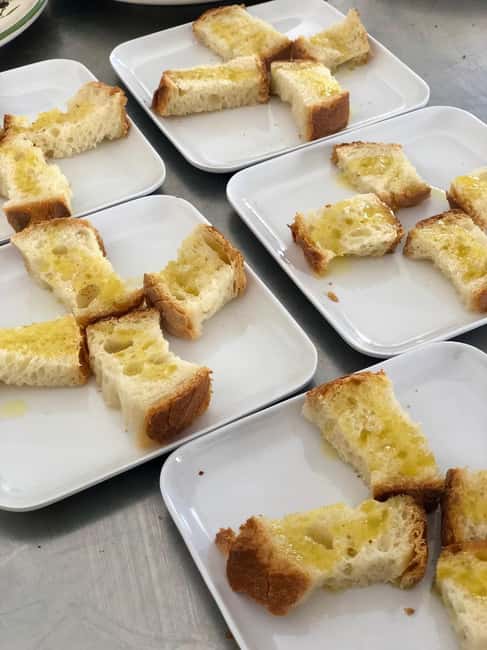
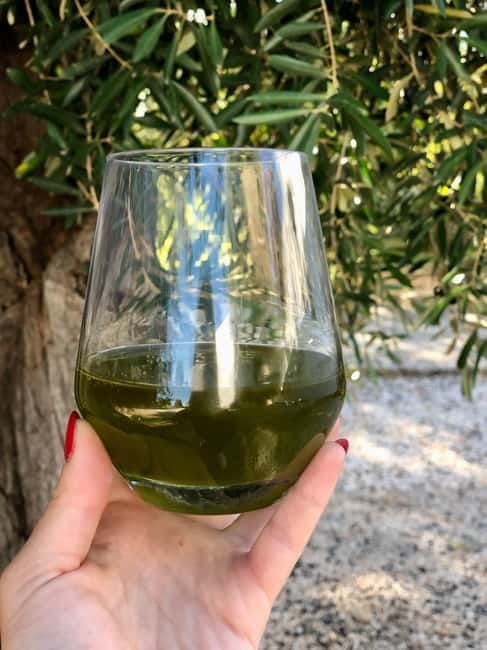
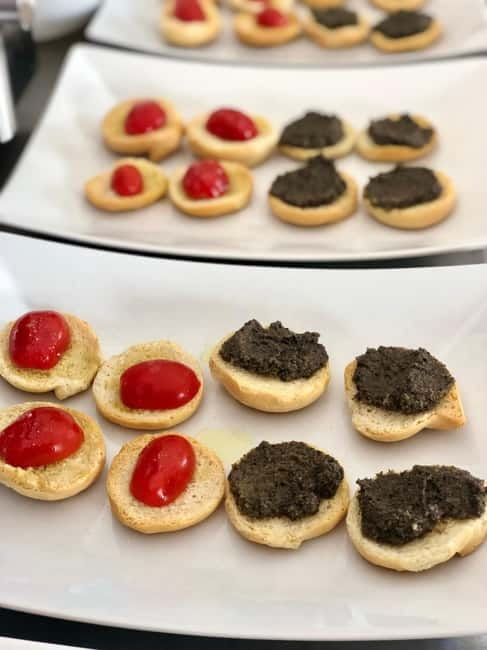
The tour ends with a tasting of three types of oil, served with friselline and water. Friselline are crisp, twice-baked Apulian bread rings, a natural partner for olive oil and a useful way to taste the product without a complicated meal getting in the way.
The tasting is short, but it has a purpose. You learn to notice the smell, flavor, and character of extra-virgin olive oil rather than treating every bottle as the same. Several visitors say the oils were unusually flavorful, with some describing the tasting as an eye-opening lesson in the difference between quality oil and ordinary supermarket oil.
I appreciate that the tasting comes after the farm and mills. You already understand where the olives grow and how they are processed. The final sample then feels connected to the place instead of being a sales counter with a backstory attached.
The three oils may not be served as a full food pairing. One critical assessment found the tasting modest, with only a small amount of oil on a piece of bread. Another wished the tasting had lasted longer and suggested that including a basic store-bought oil would have made the contrast clearer.
That is fair criticism. If you expect a long food experience with several dishes, this will feel limited. If you want a compact introduction to how to taste olive oil, it does the job. You also get water, which is useful for clearing your palate between samples.
There is usually an opportunity to buy the farm’s oil after the tasting. The products are described as reasonably priced, and several visitors bought tins to take home or give as gifts. The purchase is optional, but tasting first lets you make an informed choice instead of buying a bottle simply because the label looks attractive.
More Olive Oil Tours around Italy:
- Sorrento Farm and Food Experience including Olive Oil, Limoncello, Wine tasting
★ 5.0 · 2,524 reviews - Olive oil tasting in Sorrento
★ 5.0 · 434 reviews - Sorrento: Lemon, Olive Oil and Wine Tasting Tour with Lunch
★ 5.0 · 300 reviews - Alghero: Wine and Olive Oil Tasting at a Local Farm
★ 4.8 · 294 reviews
What the guide adds to the visit
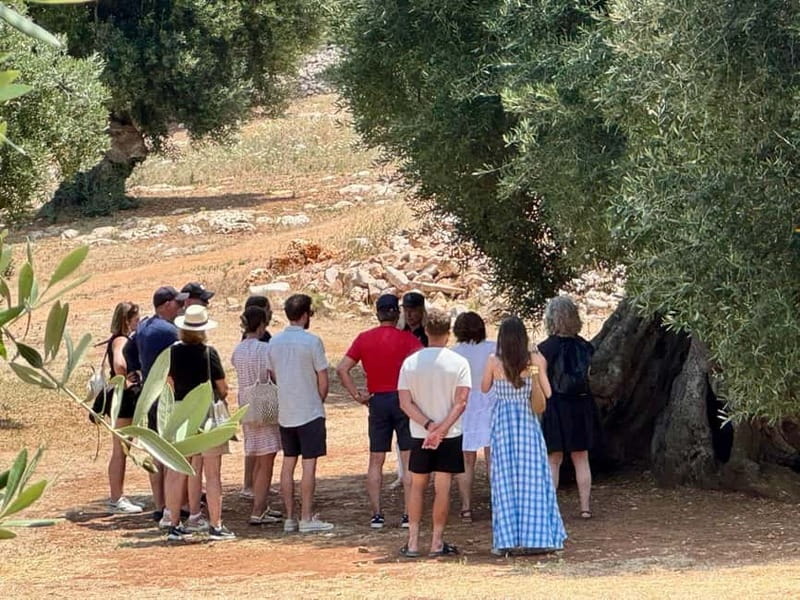
The guide can make or break a short tour, and this experience benefits from its personal approach. Julia is repeatedly praised for her clear English, warmth, and strong connection to the farm. Other visits have been led by Chiara, with similar praise for explanations of traditional production and modern organic methods.
The family connection matters. You hear about the farm from people involved with its work, rather than from a guide reading a general script about Puglia. That gives the history a human scale and helps explain why the old trees are treated with such care.
The best presentations cover several layers at once:
- the age and shape of the olive trees
- the role of olive oil in local life
- the older cave pressing system
- the modern production process
- the effects of disease on regional olive growing
- how to recognize good extra-virgin olive oil
Guided tours are offered in Italian and English. Some material may remain in its original language, so English speakers should confirm the language at the time of booking if that matters to them.
The experience has earned a 4.8 rating from 261 reviews, with especially strong praise for the guides, the ancient trees, the cave mill, and the oil itself. That pattern is useful: the most reliable strengths are the personal explanation and the historic setting, not an elaborate meal or a long tasting session.
Is $33 a fair price?
At $33 per person, I consider this good value for a short experience near Ostuni. You receive a guided visit to the grove, access to the old underground mill, a look at the modern mill, three oils to taste, friselline, and water.
The price makes most sense if you are already spending time in the Ostuni area and want something beyond the white-stone old town. It adds a rural side of Puglia that you cannot get from a walking tour through the city center.
The tour lasts 1.5 hours, though one visitor found that it often ran 10 to 15 minutes late and suggested allowing closer to 1 hour and 45 minutes. I would not schedule a tight connection immediately afterward. That small time cushion also lets you ask questions or browse the products without feeling rushed.
Compared with a full farm meal or a longer cooking class, this is a lower-cost introduction. The tradeoff is simple: you get history and tasting, but not an extensive meal or a long hands-on workshop.
Getting to Masseria Rienzo near Ostuni
The meeting point is Masseria Rienzo, and the tour returns there after the visit. The farm is close to Ostuni, but it is not presented as a convenient walk from the town or train station.
You should plan on reaching it by car or taxi. One visitor specifically wanted a shuttle from the train station and found walking there unsafe, even though the distance did not seem great. That is important practical advice. Do not rely on a short map distance alone when planning your arrival.
A car also makes this experience easier to fit into a day of exploring the countryside around Ostuni. You can visit the farm, then continue to another town or coastal stop without arranging several separate transfers.
Check the available starting times before booking. Free cancellation is offered up to 24 hours in advance for a full refund, and you can reserve while paying later, which helps if your Apulia schedule is still shifting.
Who will enjoy this tour most?
I would recommend it most strongly to you if you like food with a clear connection to its origin. The tour is also a good fit for people interested in farming, archaeology, family businesses, and the everyday traditions that shape Puglia.
It suits couples, families with older children, and anyone on a road trip through the region. The short length makes it easy to add to a day near Ostuni, though you should allow extra time for the occasional late start.
You may want a different experience if your main goal is a large meal, a lengthy tasting, or a hands-on cooking lesson. The tasting is informative but compact, and the bread and oil are not meant to replace lunch.
I also think it works well early in your visit to Puglia. Once you understand how local olive oil is grown, processed, and tasted, you will look at bottles in shops and restaurants with a sharper eye. That is a useful souvenir, even if you do not take home a tin.
Should you book the Masseria Rienzo experience?
Yes, if you want a short, well-priced look at Puglia’s olive-growing tradition with real historical depth. The ancient trees and underground cave mill give this visit more substance than a basic farm tasting, while the modern mill keeps the story connected to present-day production.
Book it if you can arrange a car or taxi and if you are happy with a concise tasting rather than a full meal. Allow about 1 hour and 45 minutes in your schedule, wear sensible shoes, and bring questions for the guide.
I would skip it only if you have little interest in olive oil or need a perfectly timed public-transport connection. For most people visiting Ostuni, though, this is an easy way to see the countryside, learn something useful, and taste an excellent local product at its source.
FAQ
Where does the tour begin and end?
The tour begins and ends at Masseria Rienzo near Ostuni.
How long does the experience last?
The stated duration is 1.5 hours. One visitor noted that the tour can run 10 to 15 minutes late, so allowing closer to 1 hour and 45 minutes is sensible.
What languages are available?
The live guide is available in Italian and English. Some content may be presented in its original language.
What is included in the tasting?
You taste three types of olive oil and receive friselline and water.
Can I visit both an old and a modern oil mill?
Yes. The visit includes a guided tour of an underground cave oil mill and a modern olive oil mill.
Can I cancel the booking?
You can cancel up to 24 hours before the experience for a full refund. A reserve-now-and-pay-later option is also available.
Just added around Italy
- Villa Castelli: Highlights Walking Tour w/ Olive Oil Tasting★ 4.8 · 12 reviews
- Umbria: E-Bike Rental and Fresh EV Olive Oil Tasting★ 5.0 · 4 reviews
- Vernazza (5 Terre): olive grove tour and oil and wine tasting★ 5.0 · 9 reviews
- Trieste’s Essence: Wine and Olive Oil Tasting★ 5.0 · 3 reviews
- Half-Day Chianti Wine and Olive Oil Tour from Viareggio★ 4.0 · 5 reviews
- From Venice: Olive Oil & Wine Tour in the Venetian Hills★ 5.0 · 9 reviews
- Valpolicella Wine and Olive Oil Tasting with Lunch from Verona★ 5.0 · 2 reviews
- Private Tuk Tuk Tour of the Millenary Olive Groves in Ostuni★ 5.0 · 4 reviews
Olive Grove Walks, compared.
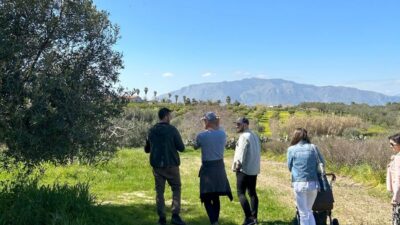
Olive Grove Tour with Wines & Olive Oil Tasting
Read our review →
Traditional Olive Grove and Dragon Fruit Farm Tour
Read our review →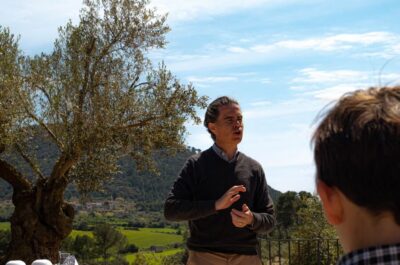
Visit of the olive grove, olive oil tasting and snack
Read our review →
Bologna: Olive Grove and Vineyard Tour with Product Tastings
Read our review →
Balestrate Olive Grove Tour: Wine and Olive Oil Tasting
Read our review →
Guided tours of the olive grove with oil tasting.
Read our review →
Organic Olive Grove tour & Olive oil tasting & lunch in Kalamata!
Read our review →
Jaen: Olive oil tour with the 5 senses, grove and tasing
Read our review →Browse the lists this tour appears in